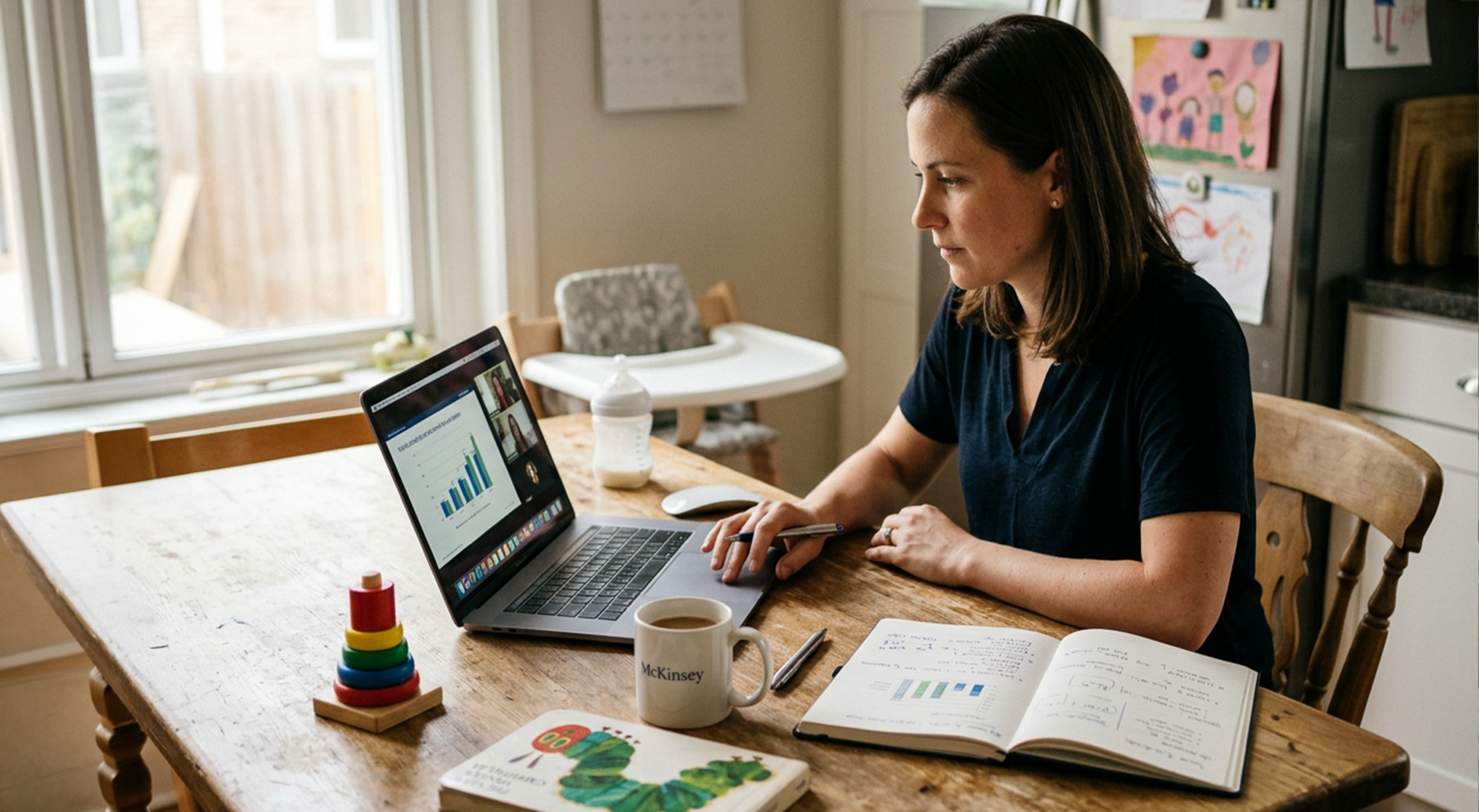
A client call taken from a kitchen table instead of an airport lounge, the novelty of finishing a deliverable without missing a workout, the joy of an afternoon coffee with a loved one… I still remember the texture of those early COVID-19 pandemic weeks in consulting. For a moment, an industry built on constant motion made room for a different rhythm of life. That moment did not last.
Back in 2016, Gravitas Global was founded and it set out to build a global community of management consultants drawing on three principles: Depth, Commitment, and Impact. From the start, the firm took pride in creating equitable opportunities for women. It was, in a sense, a bet that inclusion and competitiveness were one.
For consultants, the job has always meant frequent travel, long hours, and high-pressure timelines. During the pandemic, remote work gave working mothers what the industry rarely offers: a breathing room. As COVID-19 faded, client expectations shifted back toward in-person work, and the pressures on female consultants began to mount again. Client organizations cited reasons such as data confidentiality requirements, the need for proximity, and a greater visibility into consultants’ work. None of these reasons were unreasonable; but they rebuilt the conditions that had once made the job hardest for mothers.
A rise in concerns about career growth is witnessed, concentrated among mothers. Concerns about whether the shape of the job could coexist with the shape of our lives. How could a consultancy support its female consultants, especially mothers, in this work environment?
A firm that solves the “mothers in consulting” problem is not only solving a retention issue. Inclusion stops being a cost line and starts looking like a competitive talent strategy. I do not think this is a matter about consulting, though. Consulting is just an intense version of what happens across professions. Many industries loosened their expectations during the pandemic out of necessity, and many are unwinding that flexibility for reasons that sound sensible in isolation – proximity, visibility, “culture” – but that collectively recreate the conditions that pushed caregivers, disproportionately women, out of demanding careers long before COVID existed.
Shelley Zalis, writing in Forbes, has pointed to LinkedIn co-founder Reshma Saujani’s finding that 455,000 women left the U.S. workforce in the past year, with caregiving cited as a key reason, alongside reporting on how even senior-level mothers are being pushed out despite decades of investment in developing them. Zalis’s argument is that this is a structural failure since it is assumed that we are still built around a one-earner or one-caregiver household model that stopped describing most families.
Here is what actually helped at Gravitas…
Mothers at Gravitas described what made the difference. When asked, remote work came up as the biggest enabler, especially in the postpartum months: it let mothers stay physically close to their infants, stay professionally engaged, and avoid unpaid leave. But a more subtle theme ran just as strong: trust. Being allowed to manage one’s own time, and being able to talk about family obligations without it counting against you, mattered as much as any formal arrangement.
“At Gravitas, flexibility is cultural rather than contractual, you don’t spend your energy justifying it. You spend it on your work and your family, which is exactly where it belongs.” – H.B.K.
“Flexibility allowed me to continue breastfeeding and maintain physical proximity, without unpaid leave.” – R.H.
Yet, in consulting, there still is a cost that does not disappear…
Formal or legal accommodations, from breastfeeding hours to remote-work flexibility to general “family-friendly” framing, collapsed at times under consulting’s actual operating norms: client on-site expectations, face time treated as a proxy for commitment. Every respondent described a cost carried personally: the emotional weight of guilt and postpartum recovery while working, and a more diffuse cost of stepping back from opportunities and carrying a mental load of tracking both work and family. Even in supportive environments, the trade-offs do not disappear: what changes is whether the mother carries them alone or the workplace shares the weight.
Here are some messages mothers at Gravitas wished to relay…
Ambition does not disappear with motherhood; priorities shift. Physical presence should not be mistaken for productivity. Legal minimums, like the maternity leave period, fall short of what is needed. And perhaps the sharpest reframe: flexibility should be treated as a necessity, not a favor that has to be earned and re-earned.
“Working mothers are running machines that don’t shut down… We don’t ask for less responsibility or lower standards. At Gravitas, we get trust and a culture that recognizes the invisible work we carry.” – H.B.K.
“Flexibility isn’t a favor extended to working mothers – using it is not a sign of reduced commitment.” – M.Z.
In a public LinkedIn poll, Gravitas also asked whether workplace policies and flexibility measures make it easier for mothers to juggle demanding priorities; half of respondents said yes, that they make a genuinely positive impact. A third said the measures help only to an extent, and come with real trade-offs. Just under one in five said the pressure remains regardless. Flexibility measures are working for a meaningful share of mothers, but the remaining compromises and pressure are not edge cases.
In April 2026, I became a mother myself, after two decades in consulting. I had always had mothers on my team, and I believed I was accommodating and empathetic toward them. It was only once I lived the experience myself that I understood its full weight. Everything I had heard was real and shared. It may even be universal. Being part of Gravitas made an invaluable difference: my work was scheduled around my baby’s priorities, rescheduled commitments felt unremarkable, certain milestones bent to fit what I could take on as a leader, and I was asked, again and again, how I was doing and what would make work and life easier. Above all, it was my team, the ones who had walked this path before me, who stepped up. “It takes a village to raise a child” – African Proverb.